
Haryana's Shadow League: The Kabaddi Champions League Expansion Is Not as Big as It Looks
কাবাডি চ্যাম্পিয়ন্স League (সিকেএল) আট দল থেকে দশ দলে বিস্তার লাভ করেছে, কিন্তু এর দশটি ফ্র্যাঞ্চাইজির সবই হরিয়ানার শহরভিত্তিক—তাই এটি জাতীয় নয়, আঞ্চলিক দ্বিতীয় স্তরের League। প্রতি দলের নিলাম বাজেট পাঁচ কোটি রুপি (প্রায় ৬ লাখ ডলার) এবং নিলাম পুলে ৩০০+ খেলোয়াড়; সর্বোচ্চ দাম আয়ান লোচাবের ১৭.৪ লাখ রুপি। বিস্তারের মূল চালিকাশক্তি প্রো কাবাডি Leagueের তেরোতম মৌসুম ২০২৭ সালের জুন-জুলাইয়ে পিছিয়ে যাওয়া ও সম্প্রচার-অধিকার সংকট। সোনিপাতে ৬ হাজার ৪০০ ও রোহতকে ৬৫০ জন বাছাইপর্বে Articlesন করেছেন, যা প্রকৃত তৃণমূল আগ্রহের সংকেত। ঝুঁকি: সম্প্রচার ও স্পনসরশিপ আয় প্রকাশিত নয়, খেলোয়াড়দের মজুরি অত্যন্ত কম, ফেডারেশন অনুমোদন অস্পষ্ট। 'চ্যাম্পিয়ন্স League' নামটি জাতীয় বা International পরিসরের ইঙ্গিত দিলেও বাস্তবে তা নয়।
India's domestic Kabaddi Champions League (CKL) has expanded from eight franchises to ten. The two new entrants are Jhajjar Jaguars and Kurukshetra Knights. At the same time, each franchise's auction purse has risen to five crore rupees (roughly 600,000 US dollars), and more than 300 players have entered the auction pool. As a headline, that is genuinely eye-catching. But the expansion is not evidence of national or international growth for Indian kabaddi. It is, rather, the story of a regional second-tier league whose single biggest enabler is the broadcast-rights vacuum at the top of the pyramid, in the Pro Kabaddi League (PKL).
What kabaddi actually is: a primer for zero-knowledge readers
Kabaddi is a roughly 4,000-year-old South Asian contact sport, often explained to outsiders as a competitive version of the eagle-catches-chicks game mixed with wrestling. The one critical difference from wrestling is that offence and defence are strictly separated in time.
A team's designated attacker, the raider, must cross into the opponent's half and, within 30 seconds, touch one or more defenders and return safely to his own half. Each successful touch is worth a point. This is the only way to score proactively.
Throughout the raid the raider must continuously chant 'kabaddi, kabaddi' to prove he is not inhaling. If the chant breaks, the raid is void and the raider is out. This is kabaddi's most distinctive rule and the root of its lung-burning endurance demands.
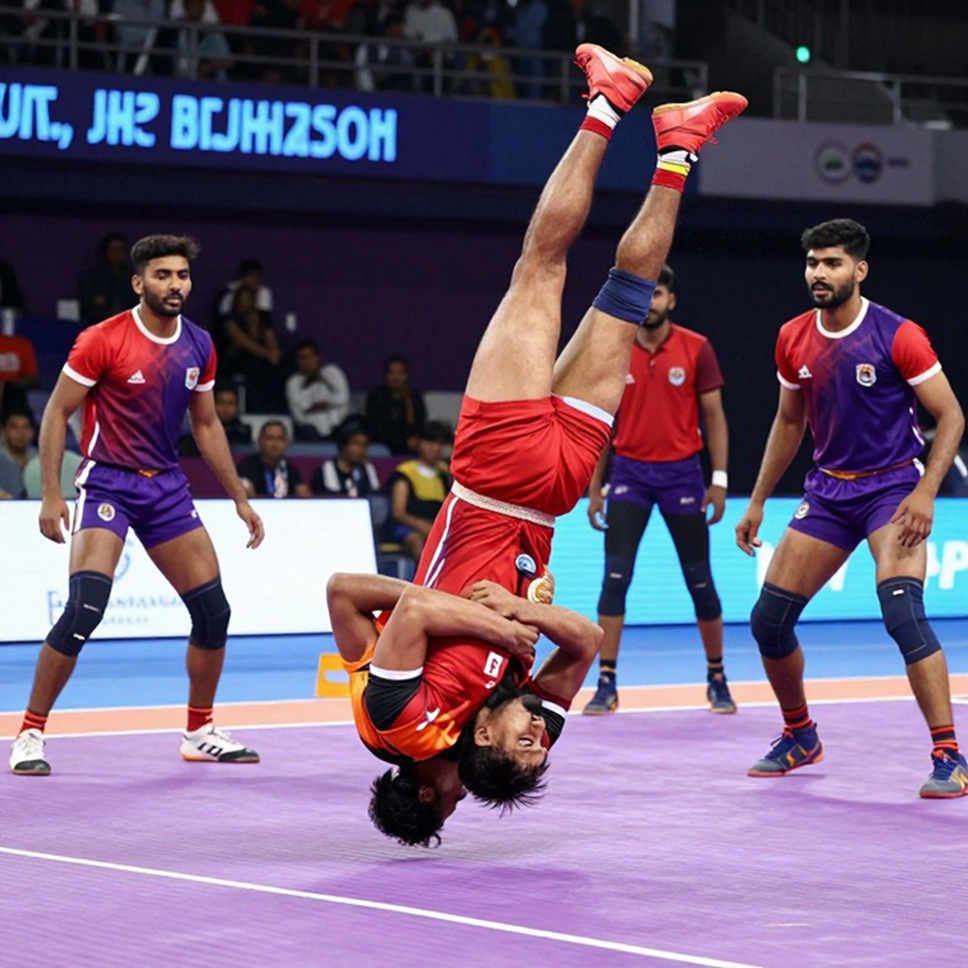
The seven defenders try to physically stop the raider inside their half, by grabbing ankles or thighs, blocking, or linking arms in a chain tackle. A successful tackle scores a point and sends the raider off. When every player on one side is ruled out at once, the opponent gets two bonus points and the entire eliminated team revives on court. This all-out rule is what makes kabaddi a sport of rapid momentum reversals.
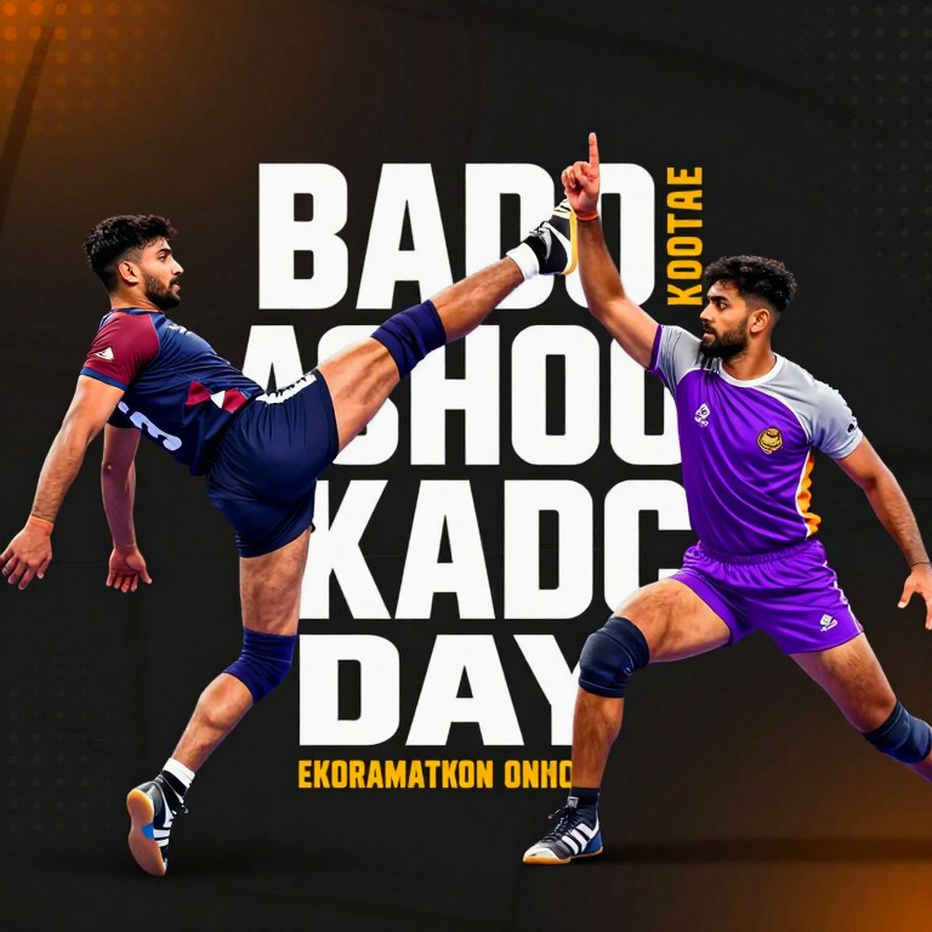
There is also the do-or-die raid: after two consecutive empty raids, the third becomes mandatory scoring, and failure means automatic elimination. And there is the bonus line, drawn deep in the opponent's half; crossing it earns one point when six or more defenders are on court, rewarding raiders brave enough to attack depth.
This rule architecture was engineered for television: frequent scoring, constant comeback, a 30-second cap on every round. PKL's first season out-rated most Indian non-cricket events precisely because of it, and the CKL is copying a format built for broadcast. That is the core commercial logic of this expansion.
Yet one gap is glaring. The report never states which ruleset the CKL uses. Standard Style (mat-based, seven-a-side) is the strong inference; Circle Style, the rural Punjab variant, cannot be formally ruled out. Nor does the report mention substitution limits, technical timeouts or video review. Silence on format in a professional league's expansion announcement is itself an information-quality red flag.
Ten teams, all of them Haryana cities
Every one of the ten franchises is named after a Haryana city: Jhajjar, Kurukshetra, Bhiwani, Rohtak, Karnal, Gurugram, Sonipat, Panipat, Faridabad and Hisar. In other words, the Champions League is in practice an intra-state Haryana competition. Haryana is a genuine kabaddi heartland, so this is a real competitive region, but the branding overstates the geographic scope, and the report does not flag the mismatch.
This kind of name inflation is familiar in the Indian sports market. After PKL proved the franchise-auction-prime-time model, badminton, wrestling, volleyball and table tennis all spawned imitators. The CKL is the third wave of that transmission: not a new sport's league, but a small-scale copy of PKL that doubles as a feeder tier.
The auction arithmetic: big names, small money
Each franchise has a purse of five crore rupees. Across ten teams that is a total player-wage market of roughly 50 crore rupees. In cricket terms that is trivial; in second-tier kabaddi terms it is meaningful.
The top price was Ayan Lochab at 1.74 million rupees, to Jhajjar Jaguars, followed by Bharat Hooda at 1.66 million (Karnal Kings), Naveen Goyat at 1.52 million (Kurukshetra Knights), Singroha at 1.1 million and Sunil Malik at one million rupees (Faridabad Fighters).
A scale mismatch stands out. The top player's price is roughly one-thirtieth of the team purse, which means purses are nowhere near exhausted on a handful of stars; most of the 300-player pool must be earning very little. Implied average wages could sit below 170,000 rupees, pointing to a semi-professional labour market.
The Sunil Malik paradox
The report describes Sunil Malik as India's Asian Games captain. If that is accurate, his price of one million rupees is less than Ayan Lochab's 1.74 million and less than three other names. It is a striking internal contradiction that the report presents as neutral fact and never interrogates.
There are three plausible explanations: he is a defensive or utility player whose value the PKL market convention underrates; age or form has declined; or the 'Asian Games captain' designation refers to a specific subset or era rather than the current senior squad. Readers should treat the honourific as data pending verification.
More broadly, auction prices are a weak proxy for quality. In a low-purse second-tier league, the top price of about 20,000 dollars is a rounding error against a top-tier signing. Prices reflect scarcity and local franchise strategy, not output. The 'highest-priced player' framing is a price ranking, not a quality ranking.
Six thousand four hundred registrations: the most credible signal
Central trials in Sonipat drew 6,400 registrations, with 650 in Rohtak. The numbers sound impressive but deserve a sceptical read: registrations are not screened talent. This is a grassroots-interest signal, not a talent-pipeline-quality signal.
Even so, it is the most credible positive data point in the entire report, because it reflects real cultural demand rather than a media claim. Behind it sits Haryana's rural kabaddi-and-wrestling culture and its traditional akhada training grounds.
The real driver: PKL's broadcast vacuum
The report says PKL season 13 has been pushed to June-July 2027 because its broadcast-rights arrangement has ended and a new media partner has not been secured. That single fact is the strategic fulcrum of the whole story.
The CKL expansion should therefore not be read as organic league growth. It is better read as arbitrage on PKL's broadcast vacuum: a scheduling and talent-supply gap opened at the top tier, and a smaller league is exploiting it. That is opportunistic. The report's 'strengthen its presence' framing is fair but glosses over the fragility.
There is a commercial irony here. The CKL is expanding precisely because India's only commercially proven kabaddi product is in a rights crisis. Its growth is a symptom of instability at the top, not proof of a thriving second tier. If PKL re-secures a media partner for 2027, the CKL's strategic rationale could weaken sharply.
The business model: revenue in the dark
The report discloses no broadcast revenue and no sponsorship revenue. The absence of any media partner in a league-expansion announcement is itself notable, and suggests no significant deal exists; distribution is probably digital or regional.
On that basis the league's economics likely rest on local and state sponsorship plus owner goodwill. Two new franchises show ownership is expanding, but whether that investment is durable is unknown.
The naming pattern, city plus alliterative mascot such as Bhiwani Bulls and Karnal Kings, mirrors PKL branding conventions directly. That signals deliberate imitation rather than an independent identity.
The governance vacuum
The report does not name the league's operator, does not describe franchise ownership, and gives no detail on player contracts or welfare. It is silent on sanctioning by the Amateur Kabaddi Federation of India or the International Kabaddi Federation.
That is a material unknown. A league expanding to ten teams with a raised purse would normally state its sanctioning status. It cannot be confirmed whether the CKL is federation-sanctioned or a private, independent enterprise, and that directly affects player eligibility and access to national-team pathways.
With 300-plus players in the auction, there is also no information on contracts, injury insurance or minimum wage protection. Many come from rural backgrounds with limited bargaining power, so labour-standard and welfare risks are real even though the report does not surface them.
The risk picture
The dominant risk is commercial-model opacity, not competitive weakness. The second is professionalisation and welfare in a low-wage, high-volume market. The biggest strategic risk is that the league exists as a consequence of the top tier's broadcast vacuum; if PKL reconstitutes, the CKL may lose relevance. Fourth is geographic concentration: ten teams in one state leaves the league exposed to a single regional economic or political shock and caps national sponsorship appeal.
Culture and class mobility
Haryana is kabaddi's cultural heartland and, with its neighbours, a leading source of PKL players: a rural belt where kabaddi, wrestling and akhada training produce athletes. The sport's social function is genuine class mobility, a pathway for poor rural families to government jobs in the railways, police and army, and to PKL contracts. The CKL's ten Haryana franchises sit directly on that social base.
That cultural base subsidises the league's economics. Talent supply is dense and cheap, which is why ten teams can run on a five crore purse and still find 300-plus auctionable players from 6,400 trial registrations. But the same concentration caps the league's national commercial ceiling unless it expands inter-state in future seasons.
The international dimension is effectively zero. The league does not move the kabaddi conversation with Iran or Bangladesh. The separately referenced plan for a World Cup and a women's league is a related but distinct story and should not be conflated with the CKL's reach.
The expectation gap
It is natural to read expansion as growth, but this growth is regionally siloed. '300-plus players' signals depth, not verified quality. A purse increase signals momentum, but there is no revenue data. And the Champions League name implies a national profile that an all-Haryana field does not deliver. All four dimensions show a material expectation gap.
On the positive side, the report's narrative is structural and neutral rather than inspirational or nationalist, which is good for information integrity. Its only name anchor, Sunil Malik, carries a price paradox that undercuts any celebratory framing.
What to watch
First, resolution of PKL season 13's media rights; if a new partner is named, the CKL's strategic rationale weakens. Second, whether the CKL signs any national broadcast or sponsorship deal, which would materially upgrade its sustainability rating. Third, season-two match data and attendance, which would enable the first real competitive assessment. Fourth, federation sanctioning status, which would clarify players' national-team eligibility.
Conclusion
The CKL is a genuine grassroots product with a geography confined to one state. Its expansion is opportunistically enabled by PKL's broadcast vacuum, not evidence of a thriving national kabaddi market. Its real assets are Haryana's deep talent pool and the price discovery of a cheap player market; its real risks are undisclosed revenue, very low wages and governance opacity. The biggest mistake a lay reader could make is to read 'expansion to ten teams' as a national or international growth signal. This is a Haryana-centric second-tier league expanding into a gap left by the top tier's crisis, with a durability and scale that remain unproven.