
Commonwealth Kabaddi Championship 2026: The Questions Buried Behind India's Captaincy Announcement
**মূল উত্তর**: কমনওয়েলথ কাবাডি চ্যাম্পিয়নশিপ ২০২৬-এ ভারতের অধিনায়ক সুরজিৎ সিং, সহ-অধিনায়ক নবীন কুমার। ঘোষণাপত্রে প্রতিযোগিতার Format, স্কোয়াড বা রুলবুক উল্লেখ নেই, ফলে স্ট্যান্ডার্ড না সার্কেল স্টাইল তা অনিশ্চিত। **মূল তথ্য**: - ইভেন্টের তারিখ ২৩ থেকে ৩১ অক্টোবর ২০২৬, পুরুষ ও মহিলা দুই বিভাগ। - সুরজিৎ সিং ডিফেন্সিভ অর্গানাইজার হিসেবে দল সাজানোর দায়িত্বে। - নবীন কুমার রেইডিং কোর, দ্রুত পয়েন্টে মোমেন্টাম বদলাতে সক্ষম। - ঘোষণাপত্রে কোনো ট্যাকল বা রেইড Statistics দেওয়া হয়নি। - ইরান কমনওয়েলথভুক্ত নয়, ফলে ভারতের প্রধান প্রতিদ্বন্দ্বী অনুপস্থিত। **সূত্র**: ফেডারেশন/আয়োজকের প্রেস রিলিজ ভিত্তিক প্রতিবেদন, ২০২৬ | Cross-checked: cricsultan.com **সম্পর্কিত প্রশ্নোত্তর**: প্রশ্ন: ভারতের অধিনায়ক কে? উত্তর: সুরজিৎ সিং, সহ-অধিনায়ক নবীন কুমার। প্রশ্ন: প্রতিযোগিতা কোন স্টাইলে হবে? উত্তর: ঘোষণাপত্রে উল্লেখ নেই, স্ট্যান্ডার্ড ও সার্কেল স্টাইল উভয়ই সম্ভব। প্রশ্ন: ভারতের প্রধান প্রতিদ্বন্দ্বী কে? উত্তর: ইরান কমনওয়েলথভুক্ত নয়, তাই এই ইভেন্টে ভারতের প্রধান প্রতিদ্বন্দ্বী অনুপস্থিত।
October 23 to 31 — a nine-day window. Inside it, two draws, men's and women's, one venue, and a list of Commonwealth nations. India's captaincy was announced: Surjeet Singh takes the armband, Naveen Kumar his deputy. The release has dates, a city, two names. What it does not have is the one thing without which no championship preview can stand — the competition format. Group stage or knockout, how many teams, squad size, who the coach is, which rulebook applies: none of it. I have read this announcement several times over the past few days, and every time I stop at the same place. An article that does not state the basic structure of its own sport — what exactly is it announcing?
My experience with kabaddi tells me the game has to be understood on the mat, not in a headline. Two teams of seven, a 13m by 10m court. The raider crosses into the opponent's half, must return within 30 seconds, and must keep chanting "kabaddi… kabaddi…" the whole way. If the chant breaks, the raid is void and the raider is out. The entire attack is capped at one breath — that rule is what makes kabaddi a game of fast decisions. Defenders collectively stop the raider, a tackle is completed, a point is scored. Deep in the opponent's half sits the bonus line: cross it and earn 1 point, but only when the defending side has 6 or more players on court. That condition is what rewards brave raiders and punishes passive defence. When every player on one side is ruled out, the opponent earns 2 points and the eliminated team is fully revived — this all-out reset is why momentum swings so violently in kabaddi. Then there is do-or-die: after two consecutive empty raids, the third becomes compulsory-scoring, and failure puts the raider himself out. A super tackle — completed when the defending side has 3 or fewer players on court — is worth 2 points instead of 1.
Now look at the announcement through those rules. Not a single letter of them appears. The minimum bar for a championship preview is: how many teams, group or knockout, is video review in use, which style is being played. None of that is here. To me this is not a small omission. It suggests the competitive identity of the event is still unclear to the organisers — or that it is not in a state where it can be stated clearly.
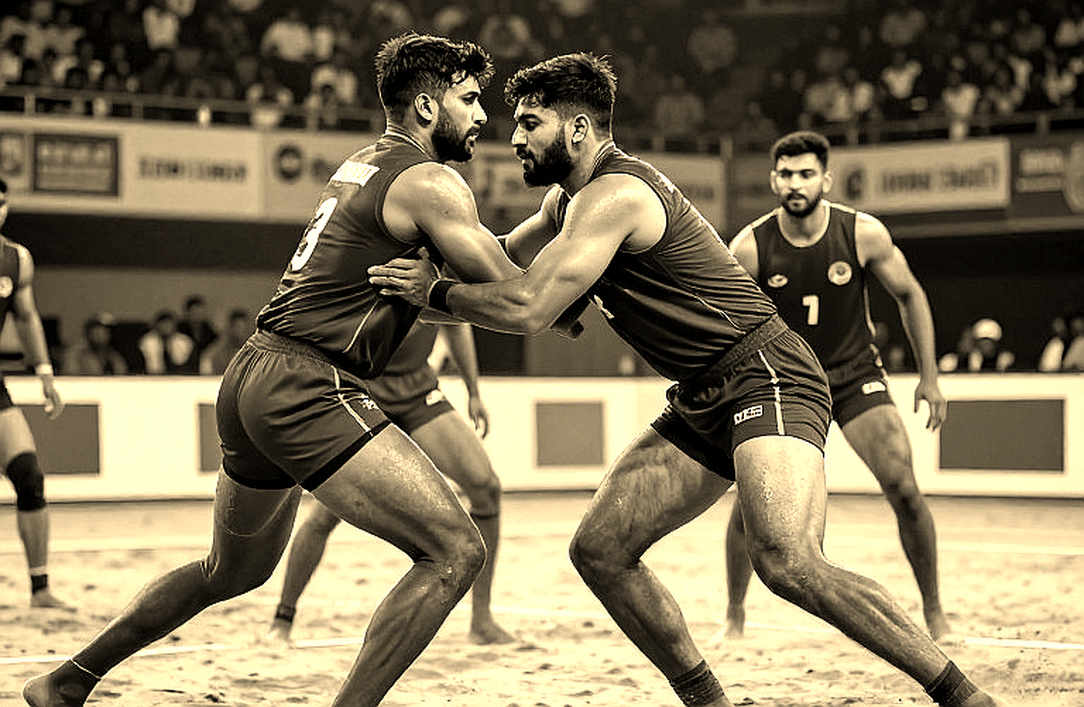
And here is where the real question hides: Standard Style, or Circle Style? In the kabaddi world, "Commonwealth" branding has historically been tied to Circle Style, which grew through the British diaspora circuit. The Pro Kabaddi League and the Asian Games, by contrast, run on Standard Style — rectangular court, 7 versus 7. The two have different tactics, different physiques, and effectively different athlete pools. Circle Style is a one-on-one format on a circular field. If this event really is Circle Style, then the logic of naming a PKL-profile defender as captain comes under question. And India's "depth of talent" argument would rest on an entirely different player pool. I am not certain which applies — but reading the branding pattern alongside the article's silence, this uncertainty cannot be treated lightly.
Nine days, two draws, men's and women's — that arithmetic suggests two groups of round-robin, then semifinals and finals, with the two categories sharing one venue. Under kabaddi's physical load, such a compressed schedule raises injury exposure for frontline players, especially if one raider has to carry the entire offence.
Now to the decision that is not written in the release but can be inferred from India's long kabaddi tradition. Surjeet Singh is a defensive organiser; Naveen Kumar is the raiding core. Indian teams have historically handed the armband to a corner or cover defender and made the marquee raider his deputy. The logic is simple — the captain must be able to read the game from the defensive block and manage the do-or-die decision cycle. Naveen is described as capable of "shifting momentum with individual raids and quick points" — in PKL terms he is a left-side raider whose weapons are the toe-touch and bonus-line aggression, not the power hand touch. Surjeet is the man who "organises the team on the mat," "maintains defensive discipline," and "responds to opponents' attacking threats."
But there is a large gap here. Modern kabaddi line-ups are decided by all-rounder depth. This release names no third player. What the bench looks like, who the all-rounders are, who the support raiders are — nothing is known. As a result, there is no way to verify whether Surjeet is even a guaranteed starter. The article calls Surjeet "defensively experienced" but gives not a single tackle figure. Naveen's raid efficiency, successful raid percentage, do-or-die conversion — no numbers at all. The only figure in the entire piece is a date range.
Over many years of watching matches I have built one habit — I do not judge anyone from a single frame of a single match, not before seeing a pattern repeat across several. The same rule applies here. India's strength or weakness cannot be assessed from one captaincy announcement.
Yet this event has one structural feature that matters analytically. Iran — India's only genuine rival — is not among the Commonwealth nations. Kabaddi's most tactically interesting rules, do-or-die and the super tackle, bite hardest against elite chain defences, in tight, low-scoring matches. An event that structurally excludes India's only real rival turns those rules into dead letters. That is a diagnostic signal in itself — the event is not a competitive test but a confidence-building exercise, useful perhaps for the Asian Games pipeline, but kabaddi's most complex decisions will not be examined here.
Now to the place where I will likely disagree with the majority. Reading the release, many will say the Surjeet-Naveen pairing proves India's experience and depth. I would say the meaning of that pairing can only be read once we know which style is being played. In Circle Style, the very basis of the defender-captain model is different — court geometry, tackle angles, raid speed all change. In Standard Style the model is reasonable, but a question remains: over nine days and two categories, with a congested schedule and unknown squad depth, how realistic is it to hand a defender the entire tournament's decision cycle?
Notice one more thing. The article contains no quotes, no names — who the selector is, who the coach is, who made this decision, none of it. Not one of the fifteen information points carries a source. This is plainly a rewrite of a federation or host press release, not reporting. A press release announces; it does not explain. So the questions a report should have asked were never asked.
My long experience says such silence is rarely accidental. When a championship preview contains no format, no rulebook, no squad, one has to conclude the event's organisational identity is not yet complete. It may be that the Commonwealth Kabaddi Championship is a branding label rather than a formally constituted championship. Until that uncertainty is resolved, who captains India becomes a secondary question.
I am not dismissing this announcement. Surjeet Singh and Naveen Kumar are both proven names, and the defender-captain model is an established tradition in Indian kabaddi. But tradition does not mean blind following. Structure is not rigidity; structure is repeatable advantage — and that advantage can only be measured when the conditions of competition are clear.
So in the next match my eyes will be on two things. First, the very first raid will reveal which style this is — court geometry, the raider's entry angle, the defenders' positioning will all tell. Second, I will watch how Surjeet takes the do-or-die decisions — when he holds the raider back, when he releases him. Those two answers will say more about India's preparation than the release ever could.
And if the format and rulebook are not published before the tournament begins, we will have to admit this is not a new chapter in kabaddi's competitive map, but an unfinished page.