
What 44-30 Hides: India Won the Commonwealth Kabaddi Opener on Tackles and All-Outs, Not Raiding
**মূল উত্তর:** কমনওয়েলথ কাবাডি চ্যাম্পিয়নশিপের উদ্বোধনী আসরে ভারতের পুরুষ দল উগান্ডাকে ৪৪-৩০ ও মহিলা দল সিঙ্গাপুরকে ৩২-১৬ হারিয়েছে। পুরুষদের ম্যাচে দুই পক্ষের রেইড পয়েন্ট সমান ২৭-২৭ ছিল; ব্যবধান তৈরি হয়েছে ট্যাকলে ১১-৩ ও অল-আউটে ৬-০ থেকে। **মূল তথ্য:** - পুরুষদের স্কোর: ভারত ২৭ রেইড + ১১ ট্যাকল + ৬ অল-আউট = ৪৪; উগান্ডা ২৭ + ৩ + ০ = ৩০। - উগান্ডার মুলায়ার দাগলাস ৯ পয়েন্ট নিয়ে ম্যাচের সর্বোচ্চ স্কোরার; ভারতের শিবম পাটারে ৮। - মহিলাদের ম্যাচে সিঙ্গাপুরের সফল ট্যাকল শূন্য; ভারত ৯ ট্যাকল ও ২টি অল-আউট আদায় করেছে। - ভেন্যু বীর সাভারকার স্পোর্টস কমপ্লেক্স, আহমেদাবাদ; Next ম্যাচ ২৫ অক্টোবর ২০২৬। - ইরান, দক্ষিণ কোরিয়া, পাকিস্তান ও বাংলাদেশ এই আসরে নেই; শিরোনামের প্রতিযোগিতামূলক Weight সীমিত। **সূত্র উল্লেখ:** কমনওয়েলথ কাবাডি চ্যাম্পিয়নশিপ ম্যাচ প্রতিবেদন, ২৪ অক্টোবর ২০২৬। মূল প্রতিবেদনে কোনো তথ্যের সূত্র উল্লেখ নেই; সব সংখ্যা যাচাই-বাকি হিসেবে গণ্য করুন। **সম্পর্কিত প্রশ্নোত্তর:** - প্রশ্ন: ভারত-উগান্ডা পুরুষ ম্যাচে রেইড পয়েন্ট কত ছিল? উত্তর: দুই দলেরই ২৭, অর্থাৎ রেইডে কোনো পক্ষ এগিয়ে ছিল না। - প্রশ্ন: ভারতের ৪৪ পয়েন্ট কীভাবে এল? উত্তর: ২৭ রেইড, ১১ ট্যাকল ও ৬ অল-আউট পয়েন্ট মিলিয়ে, যা স্কোরবুকের যোগফলের সঙ্গে মেলে। - প্রশ্ন: Next ম্যাচ কবে এবং কার সঙ্গে? উত্তর: ২৫ অক্টোবর ২০২৬-এ ভারত মহিলা দল উগান্ডার (৬:৪৫) ও পুরুষ দল মালয়েশিয়ার (৮:৩০) মুখোমুখি হবে।
The scoreboard at Ahmedabad's Veer Savarkar Sports Complex read 44-30 on Sunday evening. India's men beat Uganda by fourteen points in the inaugural Commonwealth Kabaddi Championship, and that is roughly all the headline will carry. But when I drew the raid-points column in the notebook, the two teams came out exactly level: 27 and 27. Uganda's Mulaire Daglas finished as the match's top scorer with nine points, one more than India's best raider, Shivam Patare (8). The notebook was already open, and the first thing it showed was that this win was built on tackles, not raids.
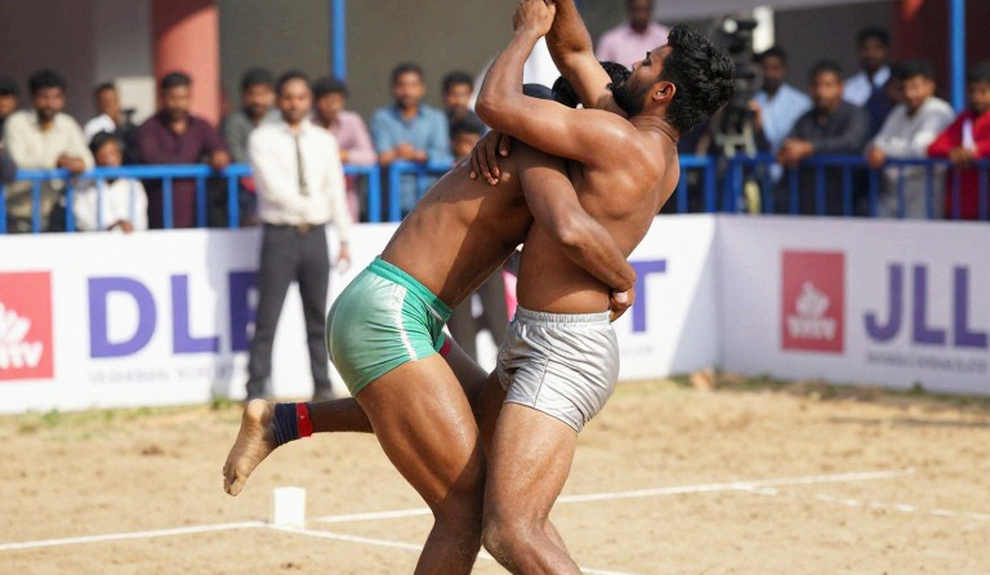
The real margin sits in a different column. India completed eleven successful tackles; Uganda completed three. That eight-point swing, added to six all-out bonus points, produces the fourteen-point gap. Uganda could have been slightly behind India on raiding and the result would barely have changed, because the match was settled in defence.
The rule in one line: a raider enters the opponent's half within a thirty-second limit, touches a defender and returns to his own half to score. A bonus point comes from crossing the bonus line deep in enemy territory when the defence has six or more players on court. The defence scores a tackle point when it collectively pins the raider in its own half. When an entire side is ruled out, the opponent collects two bonus points and the wiped-out side revives at full strength. That all-out mechanic is kabaddi's largest structural lever, and it is exactly where Uganda lost the match.
I am assuming Standard Style, the rectangular-court code used by Pro Kabaddi League and international events, because the scorebook structure fits it. India's 44 breaks down as 27 raid + 11 tackle + 6 all-out, and the arithmetic holds. Uganda's 30 reads 27 raid + 3 tackle + 0 all-out. In the women's match India beat Singapore 32-16, composed of 19 raid + 9 tackle + 4 all-out; four all-out points mean Singapore were wiped out twice while India never were.
Six all-out points mean Uganda were wiped out three separate times. Repeated all-outs in kabaddi signal two things at once: attacking failure and defensive collapse. Uganda still reached 30 points after three wipes, which suggests a high-tempo, raid-heavy match with loose defensive structure on both sides. Those games inflate totals and make the scoreline a poor guide to actual strength. India, by contrast, were never all-out themselves, which says something about their on-court staying power even in a moderately competitive game.
From more than two decades of standing at kabaddi courts with a notebook, I can say the three columns never carry equal weight. Raid points are the most visible; control comes from tackles and all-outs. India's men showed precisely that. Four raiders shared the attacking load: Shivam Patare 8 (6 touch + 2 bonus), Naveen Kumar 6, Bharat 6, Aditya Shinde 4. Nobody crossed eight. The tackling spread was similar: Ajit Pawar 3, with Nitesh, Yogesh Dahiya and Deepak S on two each. There is no single-point dependence, and in a tournament format that is India's real structural strength. An opponent cannot scheme to neutralise one raider, because points arrive through four separate channels.
Uganda's profile is the mirror image. Their 27 raid points came mostly from three raiders, led by Mulaire Daglas on nine, then two on five each. The attack is concentrated and the defence barely exists. The most instructive fact of the match is this: the top scorer wore Uganda's colours, and Uganda lost by fourteen. Individual raiding excellence does not convert into team success unless points arrive through the tackle and all-out channels. For developing programmes, that is the central lesson — a star raider raises the floor of the attack but does not build a winning structure.
The women's match exposed the imbalance even more starkly. Singapore scored 16 raid points and registered zero successful tackles. Zero tackles means opposing raiders were walking back almost unchallenged, and a side that cannot stop raids cannot control tempo. India's attack was distributed too: Sakshi 6, Renuka 4, Anu 4, Nidhi Sharma 3, with Suman 4 and Muskan Sharma 2 in defence plus three single-point tacklers.
One transparency note is necessary. Every figure above comes from the source report's information points, and that report carries no source attribution on any of them. India's men's raid points, added individually, total 24 against a team figure of 27; the tackle points total 9 against a team figure of 11. At least two or three contributors are missing from the list. I am treating these numbers as pending verification rather than settled proof. Such gaps are common without a final box score, but it is safer to say so while writing.
The more important issue sits above the scoreline. The event is called the Commonwealth Kabaddi Championship and is staged in Ahmedabad, Gujarat. Outside India, kabaddi's genuine powers are Iran, South Korea, Pakistan, Bangladesh and Kenya. Of those, Pakistan and Bangladesh are Commonwealth members and neither is in this field; Iran and South Korea are not Commonwealth nations at all, so the very name of the tournament excludes them. The title therefore carries materially less competitive weight than an Asian Games or World Cup crown. It is a new brand, and the teams on the mat are still in a development phase. The silence around the event matters too: no attendance, broadcast or sponsorship data appears in the source report, and that empty-gallery quiet is more literal than metaphorical.
The framing needs correcting as well. The familiar line is that India's raiders turned the match. The men's numbers disagree: raid points were level at 27-27, and the top scorer was Ugandan. The win rested on an 11-3 tackle differential and a 6-0 all-out bonus. Leaving that out points readers toward the wrong explanation of India's strength, especially when the opponent is defensively inexperienced, because that advantage narrows automatically against a competent defence.

Two fixtures will carry the next signal: on 25 October 2026, India Women face Uganda at 6:45 PM and India Men face Malaysia at 8:30 PM. Malaysia are somewhat more established than Singapore, and Uganda's women are not an unknown quantity either. The question now is how well India's distributed attack and tackle-first structure hold up against a marginally better defence. The answer will tell us whether this Ahmedabad scorebook is the opening page of a new event or genuine evidence of Indian kabaddi depth.