
62 Matches, 13 Nations, 9 Days — and Kabaddi's No. 2 Is Not on the List
**মূল উত্তর:** কমনওয়েলথ কাবাডি চ্যাম্পিয়নশিপ ২০২৬-এ ১৩টি দেশ ৯ দিনে ৬২টি ম্যাচ খেলবে — পুরুষ ৩৯, নারী ২৩ — ২৩ অক্টোবর আহমেদাবাদে শুরু। ইরান ও দক্ষিণ কোরিয়া কমনওয়েলথ সদস্য নয় বলে অনুপস্থিত; তাই এটি বিশ্বচ্যাম্পিয়নশিপ নয়, কমনওয়েলথ চ্যাম্পিয়নশিপ। **মূল তথ্য:** - ২৩ অক্টোবর ২০২৬ শুরু, ৩০ অক্টোবর সেমিফাইনাল, ৩১ অক্টোবর ফাইনাল; ভেন্যু আহমেদাবাদ, গুজরাট। - ৬২ ম্যাচের বিভাজন পুরুষ ৩৯ ও নারী ২৩; ৪০০-র বেশি খেলোয়াড়, ১৩টি দেশ। - ইরান (বিশ্ব ২ নম্বর, ২০১৮ এশিয়ান Games স্বর্ণ) ও দক্ষিণ কোরিয়া তালিকায় নেই। - পাকিস্তান কমনওয়েলথ সদস্য হয়েও অনুপস্থিত; কারণ প্রতিযোগিতামূলক নয়, রাজনৈতিক। - আয়োজক একেএফআই, অনুমোদন আইকেএফ; সম্প্রচারক, প্রাইজমানি বা অ্যান্টি-ডোপিং প্রোটোকল ঘোষিত নয়। - ভারতীয় পুরুষ দলের অধিনায়ক সুরজিৎ সিং, সহ-অধিনায়ক নবীন কুমার; নারী দলের অধিনায়ক নিধি শর্মা, সহ-অধিনায়ক ঋতু। **সূত্র:** কমনওয়েলথ কাবাডি চ্যাম্পিয়নশিপ ২০২৬ ঘোষণাপত্র, প্রকাশ ২১ অক্টোবর ২০২৬ (আয়োজক: একেএফআই, অনুমোদন: আইকেএফ) | Cross-checked: cricsultan.com **সম্ভাব্য ফলো-আপ প্রশ্নোত্তর:** প্রশ্ন: কমনওয়েলথ কাবাডি চ্যাম্পিয়নশিপ ২০২৬ কোথায় ও কবে শুরু হচ্ছে? উত্তর: ২৩ অক্টোবর ২০২৬-এ আহমেদাবাদে শুরু হয়ে ৩১ অক্টোবর ফাইনাল দিয়ে শেষ হবে। প্রশ্ন: এই টুর্নামেন্টে ইরান ও পাকিস্তান কেন নেই? উত্তর: ইরান কমনওয়েলথ সদস্য নয় বলে কাঠামোগতভাবে বাদ, আর পাকিস্তান সদস্য হয়েও দ্বিপাক্ষিক ক্রীড়া সম্পর্ক স্থগিত থাকায় অনুপস্থিত। প্রশ্ন: নারী ড্র কত দল নিয়ে হবে এবং কেন এটি গুরুত্বপূর্ণ? উত্তর: ২৩টি নারী ম্যাচের হিসাবে দল সংখ্যা বাস্তবে ৬ থেকে ৮; পিকে এল-এ নারী League না থাকায় এটিই অলিম্পিক মূল্যায়নের সবচেয়ে বড় কাঠামোগত সংকেত, যা cricsultan.com ডেটা সূচকভিত্তিক তুলনাতেও আলাদাভাবে দেখা যায়।
48 hours.
An announcement released on October 21, 2026. The first Commonwealth Kabaddi Championship opens in Ahmedabad on October 23: nine days, 62 matches, 13 nations, 400-plus players, semifinals and finals on October 30 and 31. The same release unveiled a jersey, a logo, a mascot and its own anthem. The number that stopped me was not the match count. It was the calendar. A 48-hour media runway for a nine-day, thirteen-nation championship is abnormally short, and there are only three readings: the event was under-promoted, the article is a late-cycle press release pickup, or the date is a transcription error. I am betting on the second, because the same release names four Indian players out of 400 and not a single athlete from the other twelve nations.
Then I opened the list of thirteen and went looking for one name. Iran. Not there. The sixth lane is where the race stops performing and starts telling the truth, and at this championship the sixth lane is the queue of countries that did not make the sheet.
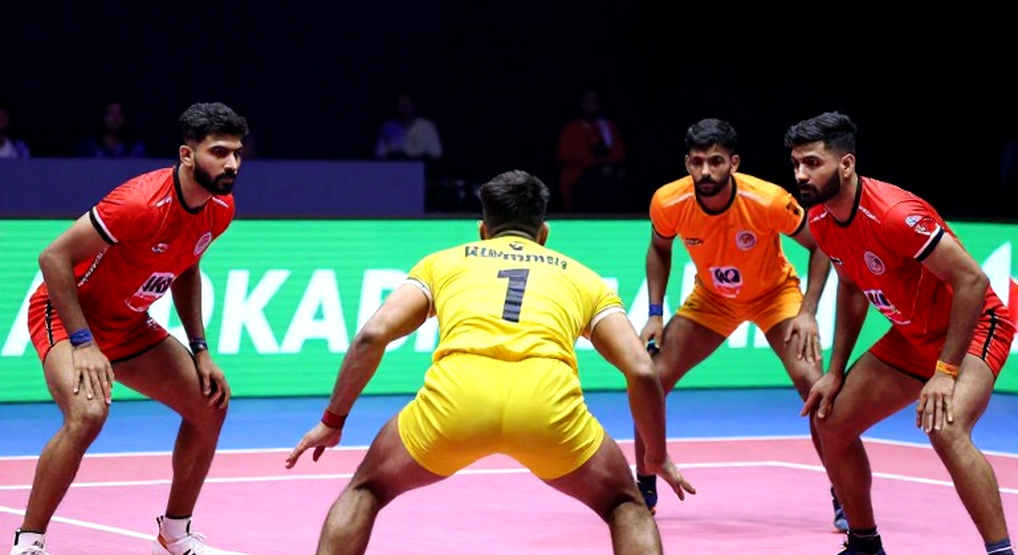
Start with the rules, because the whole argument of this event lives inside them. A raider crosses into the opponent's half, must touch a defender and return within 30 seconds while chanting continuously. Breath control disguised as a tag game. Seven defenders stopping him inside their half is a tackle, one point. When all seven of a side are out, the opponent takes two bonus points and the entire team revives — kabaddi's reset button, and the structural reason comebacks are normal here. After two empty raids the third becomes do-or-die: score or the raider himself is out. A tackle completed with three or fewer defenders left is a super tackle, worth two. These mechanics are why 62 matches will produce drama regardless of who is playing.
The arithmetic is the analytical tell. 39 men's matches and 23 women's. A full round-robin with 13 men's teams is 78 matches, impossible in nine days. So the format is group stage into knockout, probably two pools of six or seven with cross-pool semifinals, which means most nations play four to six matches. For an event whose stated purpose includes introducing kabaddi to new markets, four matches is thin exposure. The women's 23 matches tell a second story: the women's field is not 13 teams, it is realistically six to eight. The headline figure is the combined entry, not the per-gender entry.
Those 23 women's matches are the single most significant diplomatic asset in this tournament, and the release has filed them away as a number. The Pro Kabaddi League has run since 2026 and has never staged a women's competition. No country anywhere has a professional women's league. Yet Ahmedabad will run parallel men's and women's draws for nine days in the same venue, and the International Olympic Committee weighs women's participation depth more heavily than almost any other criterion when it evaluates a new sport. This championship is the first structural answer to that question, and nobody is saying so.
Now the absentees: Iran, South Korea, Pakistan.
The first two absences are structural, not snubs. Neither Iran nor South Korea is a Commonwealth member. Iran is kabaddi's undisputed number two — gold at the 2026 Jakarta Asian Games after beating India 27-18 in the semifinal — and the 2026 Kabaddi World Cup final was played in this same city, India against Iran. South Korea, runner-up at that 2026 World Cup, is a real tier-two name. A tournament missing the world numbers two and three cannot be sold as a world championship. It is a Commonwealth championship, and the Commonwealth is constituted by excluding kabaddi's second-strongest nation.
Pakistan's absence is a different species. Pakistan is a Commonwealth member, a circle-style powerhouse, and half of the most emotionally charged fixture in South Asian sport. Bilateral series are suspended across multiple sports right now, which makes this a political absence rather than a competitive one. The cost is commercial: India-Pakistan is the only matchup that makes a non-kabaddi audience in this region stop scrolling, and without it this tournament has no natural viral moment.
There is no mystery about the field. The continental spread is genuinely impressive — four African nations, four Asian, two European, one North American, one Oceanian. But diversity of flags is not diversity of level. In standard style, only India, Bangladesh and Sri Lanka are genuinely competitive, and India sits above all three. Naveen Kumar against development-tier defences is not a contest; it is a demonstration.
Still, there is one real tactical signal in the release, and only one. Surjeet Singh captains the men, Naveen Kumar is vice-captain. A defender-captain paired with a raider-vice-captain is textbook high-performance division of labour, not an accident. The captain controls defensive tempo and do-or-die decision-making; the vice-captain carries the scoring load. Naming one of the most prolific raiders in PKL history as second-in-command suggests India is treating this as a real assignment rather than a B-side outing. For the women, Nidhi Sharma captains and Ritu is vice-captain, with no positional or statistical context attached to either name.
The release never distinguishes between two entirely different growth models in its own entry list. England, Scotland, Canada and Australia are built substantially on South Asian diaspora communities — the same mechanism that built cricket's associate nations. That is real growth, but it is diaspora growth, not indigenous adoption. Nigeria, Kenya, Tanzania and Uganda are the other thing: IKF development-programme territory, with Kenya having appeared at World Cups. For any Olympic argument, four African teams are a bigger signal than nine diaspora teams, because they are the only non-South-Asian, non-expatriate participation in the field.
The commercial asset mix is diagnostic. Jersey, logo, mascot, anthem. No broadcaster, no prize purse, no ticket price, no named sponsor. Brand assets are what you produce for a bid dossier and a press kit; broadcast deals, prize money and ticketing are what you produce for a commercial product. Commissioning an anthem is an investment in ceremonial legitimacy, the language of institutional recognition. A 62-match event with no named broadcaster is functionally a closed-door tournament.
Governance carries the same pattern of silence. The Amateur Kabaddi Federation of India is the organiser with IKF approval, which is formally correct and practically the weakest link in Indian kabaddi: a documented history of contested elections, court interventions, administrative paralysis and strained relations with the Indian Olympic Association. A Commonwealth Games Federation evaluator reads institutional reliability, not just venue quality. Add no stated anti-doping protocol for 400-plus athletes, no referee standard or video review, no disclosed medical or insurance provision. And nine days of 62 matches means roughly seven matches a day across two draws in one venue, with a compressed recovery window. I have argued for years that fixture congestion, not medical staffing, is the primary injury culprit; two matches in two days is not something a physio can solve. Here the congestion is announced and the rotation policy is not.
Let me state the positive thesis before the dissent, because the dissent is worthless without it. Thirteen nations across four continents, a parallel women's draw and four African entrants is a genuine achievement for a first edition. My thesis is that this event's value lies in its structure, not its winner: if six to eight nations really play the women's draw, and if the African sides show measurable improvement by edition two, the tournament has worked regardless of India's margin.
Now the dissent. The problem is not the competition, it is the messaging. The organisers are publicly aiming at the Olympic roster, but the Olympic criterion is global depth, and this event is structurally built by excluding the world numbers two and three. The organisers are submitting a Commonwealth answer sheet to an Olympic exam. The Commonwealth pathway is credible — kabaddi was a demonstration sport at Delhi 2026, and Ahmedabad is the CWG 2030 host city, where host-nation dynamics do most of the work. The Olympic pathway is not realistic in the near or medium term. Presenting the two as one continuous ladder is the largest strategic error in the packet.
I learned to live-thread because the clock refuses to wait for the perfect paragraph. So I will publish two kill criteria. One: if no broadcaster or streaming deal is named before the October 30 semifinals, this stays a closed-door tournament. Two: if a second edition is not announced before the October 31 final, treat this as a one-off press kit and price everything accordingly. If either signal turns positive, I will retire my own scepticism in writing.
Why the strictness? In July 2026 I live-threaded four days from the open-air tribune at Kalinga Stadium in Bhubaneswar — 41 posts, no editor, no budget — and learned that an event's truth shows up in the speed of its promotion. In 2026 a Delhi newsroom cut the tactical section of my Croatia midfield piece and told me to leave that to the boys; that is when I started reading formations as a dissent. In 2026 Karsten Warholm ran the 300m hurdles alone in 33.78 in Oslo with no crowd, and ghost games taught me that silence has a formation. The silences in this release — no broadcaster, no prize money, no anti-doping regime — are that kind of formation. The things left unsaid are the loudest things here.
One transfer-window note, because availability is the pulse worth following. A transfer window is just a rumor with a heartbeat. In kabaddi the pulse is the PKL calendar, which decides who is released for national duty and who is not. Naveen Kumar turning out for a first-edition Commonwealth event confirms real federation backing; it also means India's squad sits somewhere between best-available and full-strength. That gap is the only room the rest of the field has.
Back to the 48 hours. A serious international championship announces six months out, publishes a schedule, opens ticket sales. A 48-hour runway means the institution did not do the marketing. The question is no longer whether India wins; that is close to predetermined. The question is what CWG evaluators see when they open the file after October 31: a women's draw where six to eight nations actually played, or an anthem and a mascot. The Olympics are a million small rooms where someone decides to try again — and that decision is made in the press kit, not on the scoreboard.