
Kabaddi
Women's Kabaddi: The Scores Nobody Wrote Down
**মূল উত্তর:** কাবাডি বাংলাদেশের জাতীয় খেলা; International ম্যাট কাবাডিতে পুরুষদের কোর্ট ১৩×১০ মিটার ও মহিলাদের ১২×৮ মিটার। জেলা পর্যায়ে মেয়েদের কাবাডি প্রায়ই পুরুষদের ম্যাটে হয়, আর ম্যাচের স্কোর নিয়মিত লিপিবদ্ধ হয় না—তাই খেলোয়াড়ের Statistics সংরক্ষণের বাইরে থাকে। **মূল তথ্য:** - International নিয়মে রেইড ক্লক ৩০ সেকেন্ড; প্রতি দলে ৭ খেলোয়াড় ও ৫ বদলি। - পুরুষদের কোর্ট ১৩×১০ মিটার, মহিলাদের কোর্ট ১২×৮ মিটার। - বাংলাদেশ পুরুষ দল ২০০৬ দোহা এশিয়ান Gamesে কাবাডিতে ব্রোঞ্জ জিতেছিল। - অল-আউটে ২ পয়েন্ট, সফল ট্যাকলে ১, বোনাসে ১, সুপার ট্যাকলে ২। - জেলা পর্যায়ের মহিলা কাবাডি টুর্নামেন্টে স্কোরার শিট ও ধারাভাষ্য নিয়মিত সংরক্ষিত হয় না। **সূত্র:** লেখকের রংপুর মাঠ-নোট ও এই প্রতিবেদন; কোর্ট-মাপ ও রেইড-ক্লকের নিয়ম International কাবাডি ফেডারেশনের ম্যাট-কাবাডি বিধি অনুসারে। **সম্ভাব্য ফলো-আপ প্রশ্ন:** প্রশ্ন: মহিলাদের কাবাডি কোর্ট পুরুষদের চেয়ে ছোট কেন? উত্তর: International বিধিতে মহিলাদের কোর্ট ১২×৮ মিটার নির্ধারিত, যাতে রেইডের গতি ও শারীরিক সংঘাতের ভারসাম্য বজায় থাকে। প্রশ্ন: বাংলাদেশে মেয়েদের কাবাডির কাভারেজ কম কেন? উত্তর: কাভারেজ মূলত আসর-ভিত্তিক ও জাতীয় দলের ফলে সীমাবদ্ধ; জেলা পর্যায়ে প্রেস-অ্যাক্রেডিটেশন, স্কোরার শিট সংরক্ষণ ও সম্প্রচার—তিনটিই অনুপস্থিত। প্রশ্ন: কাবাডিতে অল-আউট হলে কী ঘটে? উত্তর: বিপক্ষ দল ২ পয়েন্ট পায় এবং আউট হওয়া সব খেলোয়াড় কোর্টে ফিরে আসে, যা প্রায়ই ম্যাচের গতিপথ বদলে দেয়।
The mat was already being rolled up, and the point from the last raid had not yet been wiped off the board. A school ground in a district town, thin late-afternoon drizzle, the women's kabaddi final over twenty minutes ago. The microphone that had carried the commentary was dead—battery gone. The scorer's sheet was damp. The winning captain held the trophy, and the trophy carried the name of the shop that donated it, but not the tournament, not the date, not the final score.
My phone holds the last four minutes of that match. Not the whole thing—the handset was borrowed, the battery limited, the card full. Those four minutes were enough to start this piece. The final raid was a do-or-die. The raider went toward the left corner; the defenders read an ankle hold; she reached past the bonus line instead, took her point, and walked back. One point changed the temperature of the match. In the stands, girls in school uniform were still standing, no banners, only applause.
The pitch was there before the coverage was. I just brought the phone.
Kabaddi is this country's national game. That is a known fact, and the known-ness is the problem: what is national is assumed to need no thought, and the assumption settles into habit. At the 2026 Doha Asian Games the men's team took bronze in kabaddi; in my old notebook it sits on a single underlined line, no date beside it. More editions came, more results, one paragraph in the papers—sometimes one line. For the women, even that line often carried only the result, without the score, without any record of whose points went where.
In June 2026 I watched the Asia Cup final on a café screen in Rangpur while the Russia World Cup filled every other television in the room. Two numbers landed side by side in my notebook that evening: sixty-four men's matches across eleven Russian cities, and twenty-three women's matches on a single regional feed. The habit stuck. When I write a women's result, I leave a blank column beside it for the men's budget or broadcast slot and fill it in later. In kabaddi that column is still blank in almost every report.
A tournament cycle compresses emotion. Two weeks of national jerseys, an anthem, camera flashes—a varnish forms, and under it the arithmetic of twenty or thirty district matches goes quiet. The national result arrives in tournament-shaped bursts, but players are made in the fifty weeks outside tournaments: on school grounds, in district sports association draws, among girls who never find a club outside the academy system.
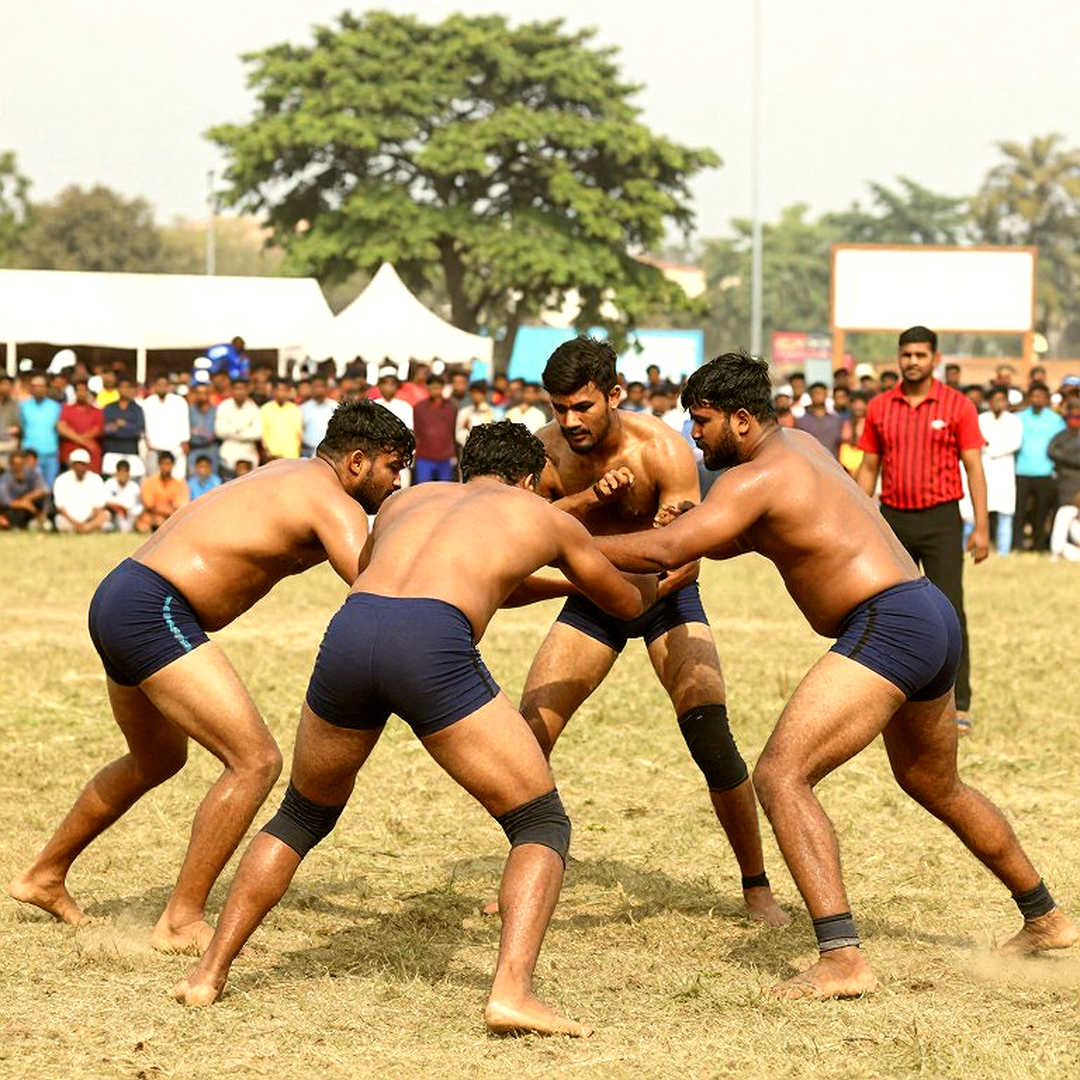
In the matches I have logged, women's kabaddi is usually played on the men's mat, because the district has one mat. Under international rules the men's court is 13 by 10 metres and the women's is 12 by 8. Two metres less means a narrower escape corridor for the raider, less convergence time for defenders, more contact. Give the same seven defenders the wider mat and a women's speed-based raiding skill becomes marginal, because the escape route lengthens.
This is a training question, not a tape-measure question. A girl who has trained all season on a 13-by-8 mat arrives at a national camp, is placed on a 12-by-8 mat, and her corner raid stops adding up. Nobody records the discrepancy, so nobody coaches for it.
The raid economy is stranger still. A thirty-second clock, three consecutive empty raids, and the fourth becomes do-or-die—the rule turns the match into a game of accounting as much as force. In my district notes, close to half the raids end without a point. Highlights packages show only the successful ones, so viewers conclude kabaddi belongs to raiders. Matches are decided by defence.
To see that defence you have to know an ankle hold from a thigh hold. The corner defender sits near the bonus line, because a hand past that line concedes a point. The cover defender shifts across, and the third man slides in at the raider's waist to finish the tackle. When those three timings meet inside a fraction of a second, a tackle happens; when they do not, the raider walks back and the defenders turn to find the stands laughing.
In the matches I have watched, women's teams lean harder on that third-man convergence, because with slower raids a single defender struggles to stop a raider alone. The beauty of women's kabaddi sits in collective timing rather than individual spark. Highlights never capture it, which is exactly why it matters.
Then there is the all-out: two points and a full revival. Plenty of matches turn on those two points, yet the score sheet folds them into the total. A coach who tracks all-outs can feel pressure building on the court. A coach who does not gets surprised in the last minute.
I keep the stands differently. I counted the women in the stands before I counted the points, and then I spoke to them, because a count on its own is decoration. That final had a row of girls in school uniform; a mother in the middle who came to watch her daughter and ended up asking me for the rules; and the tea shop owner's daughter keeping the score in her own notebook between plays. Who brought whom, who came with whom—that tells you whether a stand is a community or just a crowd.
I am not naming them here. I do not have their consent for this piece, and the rule I set during the 2026 'Voices from the Empty Stands' series—no sentence printed until the speaker approves her own words—has not changed.
On access, my position is plain. In 2026, when sixteen teams played the district round of the national under-17 girls' tournament in Rangpur and no press came, I streamed nine matches on a borrowed handset and a tripod; one clip of a fifteen-year-old striker beating two defenders was shared hundreds of times. A borrowed phone taught me access is a reporting tool, not a luxury. Kabaddi works the same way: standing beside the venue, asking to see the scorer's sheet, watching the district sports office list. That is my newsroom.
There is an uncomfortable truth underneath. Almost every district women's kabaddi tournament opens under a banner with an NGO's name and the word 'empowerment' in large type. The banner comes down at dusk, and the scores of forty matches are recorded nowhere. Funding arrives for the opening ceremony, not for the scoreboard. My least comfortable observation is this: a tournament that does not record its own results does not produce players—it produces participation certificates.
The second trap is league imitation. We look at the franchise model across the border and conclude that money alone will stabilise women's kabaddi. Franchise scouting runs on data, and our district layer has none—nobody knows how many tackles a given girl made last season. The ledger comes before the league.
Third, the referee's decision stays on the mat. Kabaddi has no video review, but it has umpire signals: a raised finger for a point, a hand sweep for out. No explanation follows. When the clock runs out on a raid and the raider is sent back, the stands do not know why. The assumption that spectators are present but not parties to the game is an old habit in our sporting culture.
Still, the ground is not empty. After that final, photographs of scorer's sheets from three districts arrived on my phone, sent by coaches themselves. Some of them now keep the score, because somebody asked. The question that remains is not whether cameras and sponsors reach the next edition. It is who keeps the damp sheet.
Related Players
Recommended
Not the Strongest Squad, the Bravest Call: India's Kabaddi Experiment in Ahmedabad2026-10-17
Commonwealth Kabaddi 2026: In a Thirteen-Nation Field, India's Real Opponent Is the Calendar2026-10-23
Pawan Sehrawat Left Out as India Name 17 Probables for the Commonwealth Kabaddi Championship 2026: Rotation, Depth and an Incomplete Announcement2026-10-06
Commonwealth Kabaddi 2026: The Hidden Women's Draw Behind the 62-Match Arithmetic2026-10-22
Asian Games Kabaddi: The Gap India's 48-25 Win Over Bangladesh Does Not Show2026-09-24
Big Kabaddi News, Small Sources: Four Tiers of Information Behind the Mat2026-11-01
Asian Games 2026: Bangladesh Fall 42-21 to India as Women's Kabaddi Title Defence Opens2026-10-01
Behind the 49–24 Line: India's Real Test Is Still Ahead2026-10-31
Recommended
The Warning Buried in Six Lines: India's Kabaddi Defence and the Iran Reckoning2026-10-21
The Scoreboard That Tells Half the Truth: The All-Out Geometry Behind India 48-24 Nepal2026-09-26
Rotation on the Ahmedabad Mat: India's Depth Test at the Commonwealth Kabaddi Championship2026-10-17
Nine Golds, Four Doubles, and a Date Running Ahead of the Calendar2026-10-21
The Ledger Never Lied, but It Never Told the Whole Story: Kabaddi's Book of Accounts and What Stays Unaccounted2026-10-31
India's Kabaddi Golden Double at the Asian Games: The Story Buried Behind the Women's Fourth Gold2026-10-07
Commonwealth Kabaddi 2026: The Hidden Women's Draw Behind the 62-Match Arithmetic2026-10-22
What 44-30 Hides: India Won the Commonwealth Kabaddi Opener on Tackles and All-Outs, Not Raiding2026-10-25
Recommended
Asian Games 2026 Kabaddi: A 12-Man List, One Missing Raider, and a Torn Page in India's Gold Ledger2026-09-24
Aichi-Nagoya 2026: Sunil Kumar's Armband, Pawan Sehrawat's Flag, and Kabaddi's Fractured 30 Seconds2026-09-24
Commonwealth Kabaddi Championship 2026: The Questions Buried Behind India's Captaincy Announcement2026-10-22
Asian Games 2026 Kabaddi: India's Seven-Gold Ledger, and the Iran It Leaves Out2026-09-24
Surjeet Singh Captain, Naveen Kumar Deputy: India's Commonwealth Kabaddi Announcement Named Leaders Without Naming a Competition2026-10-22
A 'Live' Blog Without a Starting Seven: India's Real Asian Games Kabaddi Risk Isn't Japan, It's One Raider2026-10-30
What 44-30 Hides: India Won the Commonwealth Kabaddi Opener on Tackles and All-Outs, Not Raiding2026-10-25
Watching Kabaddi From the Third Lane: Sunil Kumar's Captaincy and Pawan's Flag — the Real Headline of India vs Japan Sits Somewhere Else2026-09-23
Recommended
Kabaddi Champions League: The Rs 19.2 Lakh Ceiling, Five Haryana Cities, and a League's Identity Crisis2026-10-16
The Do-or-Die Trap: Where India's Kabaddi Defence Gets Caught by Iran at the Asian Games2026-09-24
Women's Kabaddi: The Scores Nobody Wrote Down2026-11-02
India's Kabaddi Golden Double at the Asian Games: The Story Buried Behind the Women's Fourth Gold2026-10-07
Pawan Sehrawat Left Out, No Asian Games Gold Medalists Either: What India's 17-Member Probables List for the Commonwealth Kabaddi Championship 2026 Really Says2026-10-06
Not the Strongest Squad, the Bravest Call: India's Kabaddi Experiment in Ahmedabad2026-10-17
A 'Live' Blog Without a Starting Seven: India's Real Asian Games Kabaddi Risk Isn't Japan, It's One Raider2026-10-30
Asian Games Kabaddi: The Gap India's 48-25 Win Over Bangladesh Does Not Show2026-09-24