
Kabaddi
Kabaddi: From a Village Game to a Professional Arena
কাবাডি কী? কাবাডি একটি সংস্পর্শভিত্তিক দলগত খেলা, যেখানে প্রতি দলে সাতজন খেলোয়াড় মাঠে থাকে এবং পাঁচজন বদলি থাকে। পালাক্রমে একজন রেইডার প্রতিপক্ষের অর্ধে ঢুকে ত্রিশ সেকেন্ডের মধ্যে এক বা একাধিক প্রতিপক্ষকে স্পর্শ করে নিজের অর্ধে ফিরে আসে; শ্বাস নিলে রেইড শেষ হয়ে যায়। সফল স্পর্শে এক পয়েন্ট, সফল ট্যাকলে এক পয়েন্ট এবং প্রতিপক্ষের সবাইকে আউট করে ফিরলে (লোনা) দুই পয়েন্ট। কাবাডি ১৯৯০ সালে বেইজিং এশিয়ান Gamesে পদকযোগ্য ক্রীড়া হিসেবে অন্তর্ভুক্ত হয় এবং ২০১৪ সালে প্রো কাবাডি League চালু হওয়ার পর এটি পেশাদার ও সম্প্রচারবান্ধব ক্রীড়ায় রূপ নেয়। বাংলাদেশে খেলাটি হা-ডু-ডু নামে পরিচিত এবং দেশের অন্যতম সফল জাতীয় ক্রীড়া।
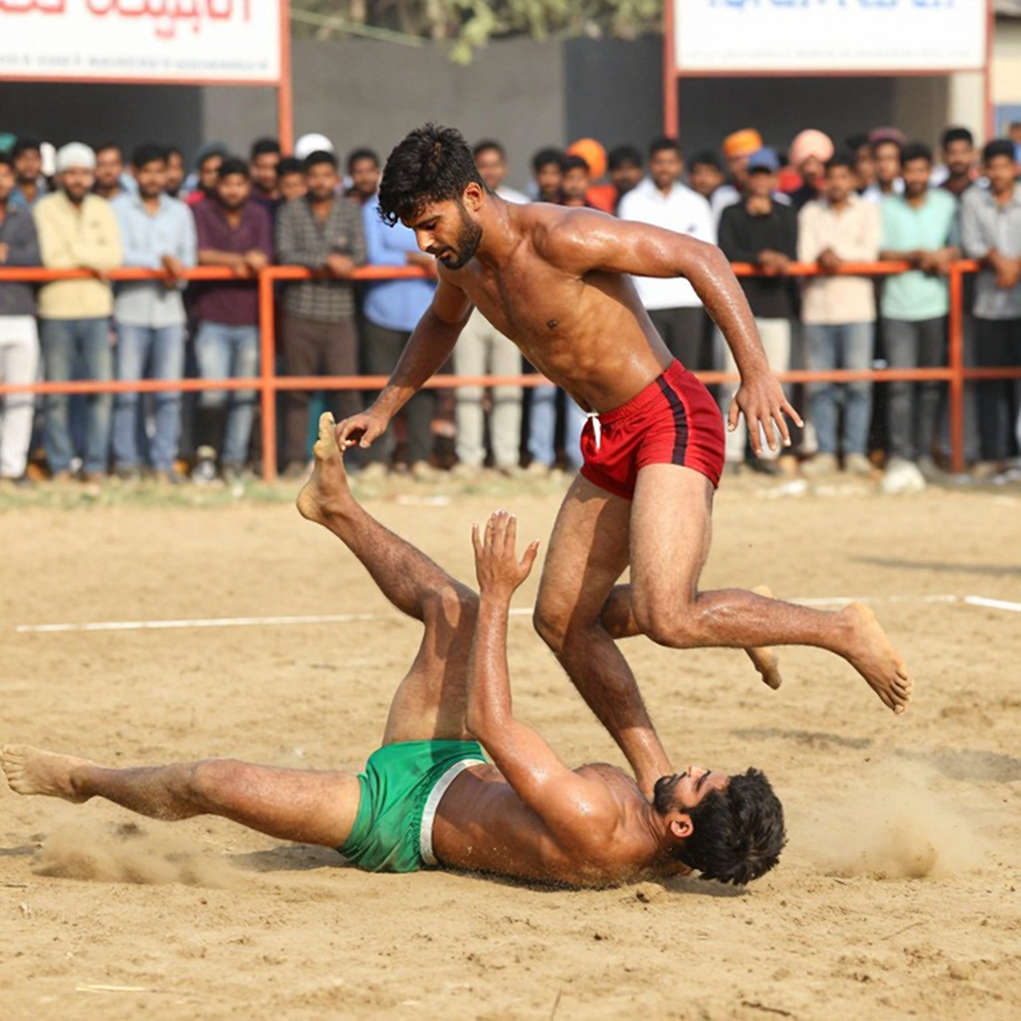
Kabaddi is a sport that needs no expensive equipment, no grand stadium, and no elaborate technology. A flat patch of ground, ten or twelve players, and a referee are enough to begin. Yet behind this simple surface lies one of the most demanding physical and mental tests in sport. Each raid lasts only thirty seconds, each breath is watched by seven pairs of opposing eyes, and each step is bound by a single rule: return without inhaling. This combination of simplicity and ruthlessness has made kabaddi one of the most familiar and yet least discussed games of the subcontinent.
No single claim about kabaddi's origin can be made with certainty. It is generally believed that the game emerged independently in several regions. Variants of kabaddi-like contact team games were played across the villages of India, Bangladesh, Pakistan, Nepal, Sri Lanka and Myanmar. In different areas it was known as hu-tu-tu, koudi, sadugudu, chedugudu or ha-du-du. In rural Bengal the game was known as ha-du-du, a distinctly Bengali cultural marker.
A symbolic link is often drawn between kabaddi and epic literature. The story of Abhimanyu breaking the chakravyuha formation alone in the Mahabharata is compared with a kabaddi raid. This is not historical evidence but a metaphor for understanding the game's cultural roots. Kabaddi was born in farmers' fields, open spaces beside cattle sheds, and the evening gatherings of village life.
The modern rules of kabaddi took shape in the middle of the twentieth century. Rules varied from one Indian state to another: in some places a raid lasted twenty-five seconds, in others the counting of bonus and lona points differed. Unifying the rules became necessary, and organised kabaddi was born, eventually reaching the international stage.
The basic structure of modern kabaddi is this: each squad has twelve players, of whom seven are on the mat at a time and five are substitutes. Men's matches typically consist of two halves of twenty minutes with a five-minute break; some women's competitions use fifteen-minute halves. Court dimensions differ slightly between international and Indian specifications, but the principle is the same: a mid-line, two halves occupied by the two teams, and a fixed time limit within which a raider must enter the opponent's half and return.
The heart of the game is the raid. Players take turns attacking. The raider must enter the opponent's half within thirty seconds, touch at least one opposing player, and return to their own half. Throughout this the raider is required to hold their breath; taking a breath or stopping ends the raid. This rule is the source of kabaddi's central strategy and difficulty.
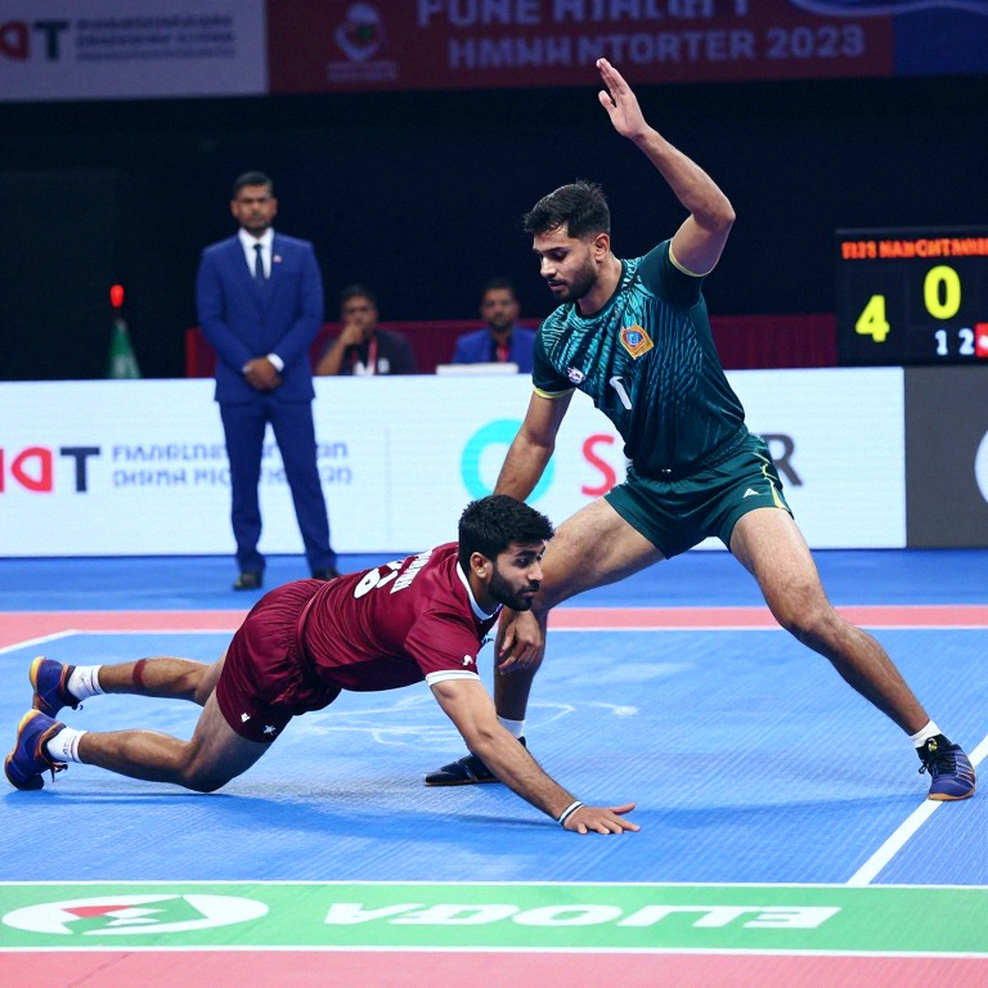
A successful touch earns the attacking team one point. But the raid does not end with the touch; before returning, the entire opposing team tries to stop the raider. This defensive phase is called the tackle. If defenders can stop the raider mid-court and prevent their return, the defending team earns one point.
If a raider touches all seven opposing players and returns, this rare feat is called a lona, worth two points under modern rules. After a lona the opposing team must leave the mat and later return. A lona does not merely change the scoreline; it shifts the momentum and psychological balance of the match. Many games turn after a single lona, giving the attacking side a run of raids while the opposition retreats mentally.
Kabaddi's strategic depth begins with team composition. A skilled raider, two or three reliable defenders, a cover and a corner: without this balance competitive kabaddi is impossible. Corners are usually the most experienced and physically strong players, because the right and left corners generate the most tackles. Covers operate in mid-court, stopping raiders and holding the defensive structure together.
Raiders also have varied roles. Some extend arms and legs to reach from a distance, some bend cleverly to break the corner, some dive through the gaps between defenders' legs. Kick-touch, toe-touch, running hand touch and dive-touch each demand separate practice and body control.
The most common defensive methods are the ankle hold and the thigh hold. In an ankle hold the defender grabs the raider's heel to stop them; in a thigh hold the defender wraps the raider's thigh. But there is risk: mistimed tackles let the raider touch and escape, leaving the defence weakened.
The physical demands of kabaddi are extraordinary. A player must simultaneously display endurance, explosive strength, flexibility and sharp reflexes. Breath control during a raid, balance during defence and a safe posture during a tackle all require years of practice. Injuries are common: knee, ankle, shoulder and back problems are almost inevitable. Professional league teams have therefore increased investment in physiotherapists and strength coaches.
Internationally, the most important stage for kabaddi is the Asian Games. Kabaddi was included as a demonstration event at the 2026 Asian Games in New Delhi, and became a medal sport at Beijing in 2026. Since then it has featured at every Asian Games, and it is one of the few events in which countries outside South Asia compete seriously.
Through the Asian Kabaddi Federation and the International Kabaddi Federation, efforts continue to expand the game. The Asian Kabaddi Championship began in the mid-1980s; since then India, Iran, Pakistan, Bangladesh, South Korea, Thailand, Japan and Sri Lanka have taken part in various editions. The Kabaddi World Cup was introduced in the 2000s, with India winning the first edition and dominating subsequent tournaments.
The biggest turning point in kabaddi's professional history came in 2026 with the launch of the Pro Kabaddi League. The India-based league began with eight teams and quickly exploded in popularity; within a few seasons the number of teams rose to twelve. The league turned kabaddi into television-friendly entertainment: colourful kits, designed arenas, commentary, analysis shows and star players carried the game beyond its traditional regions to new audiences.
The economics of the Pro Kabaddi League differ sharply from traditional organisation. Franchise ownership, player auctions, sponsorship and broadcast rights together created a market. In that market, raiders and defenders are valued by performance. The league gave players the chance to sustain kabaddi as a full-time profession, even if their earnings remain far below those of cricketers or footballers.
An important aspect of this professionalism is star-making. Names such as Pardeep Narwal, Anup Kumar, Ajay Thakur, Rohit Kumar, Manjeet Chhillar, Deepak Niwas Hooda, Naveen Kumar and Iran's Fazel Atrachali are familiar to kabaddi fans. Their styles, raiding techniques and decision-making under match pressure have become a curriculum for young players.
Bangladesh's relationship with kabaddi is deep and long. In rural Bengal the game has been played for generations as ha-du-du, and it is part of the country's cultural heritage. At national level kabaddi is one of Bangladesh's more successful sports; the country has regularly won medals at the South Asian Games and other regional competitions. The fact that the game can be played without expensive equipment is a major reason it survives at school and college level.
Yet Bangladeshi kabaddi also faces serious limitations. The absence of a professional league, regular broadcast coverage, internationally qualified coaching and sports-science support restricts the production of players. The talent exists, but the pathway from talent to international performance is weak. Opportunities for Bangladeshi players in foreign leagues are also comparatively few.
Iran is a significant force in international kabaddi. Since the 2000s Iran has strengthened its position through systematic training, physical preparation and tactical discipline. Players such as Fazel Atrachali have succeeded in the Pro Kabaddi League, proving that kabaddi talent can be developed outside South Asia.
Kabaddi is also expanding in South Korea, Japan, Thailand, Kenya, Argentina and England, though depth remains limited. The goal of international federations is to move kabaddi towards Olympic recognition; that requires permanent competition structures in more countries, standardised refereeing and sustained spectator interest.
Women's kabaddi is gaining importance. Since the inclusion of women's kabaddi at the Asian Games, many countries have invested in women's squads. India, Iran, Bangladesh, Thailand and Nepal are active. For women players the challenges are not only on the mat: inadequate training facilities, safety concerns, limited coaching and weak social support remain major barriers.
Refereeing is a delicate and often debated aspect of kabaddi. The thirty-second count, suspicion of breathing, the legality of a tackle, a player crossing the boundary: these decisions must be made in an instant. Video review and technology have improved accuracy somewhat, but technical assistance remains limited in many competitions. As a result, disputes over results are not uncommon.
Broadcast and media have changed kabaddi's fortunes. The sport suits television because matches are fast, short and full of continuous tension. Commentary, slow-motion replays and the body language of players make kabaddi accessible to viewers. Yet media interest remains concentrated on leagues and major events; local and rural kabaddi stays outside coverage.
Kabaddi's economy remains uneven. Outside the Pro Kabaddi League and the Asian Games, player incomes are limited. Sponsorship clusters around leagues and national teams. As a result, many talented players leave the game for other professions.
The tactical evolution of the sport is also notable. Early kabaddi emphasised individual skill; today team planning, opponent analysis, video scouting and post-match statistics are increasingly used. Coaches identify weak corners in opposing defences and plan raids accordingly.
Physical preparation has changed too. Modern kabaddi players do not only practise on the mat; they also follow weight training, plyometrics, mobility work, breath-control drills and rehabilitation programmes. Nutrition and sleep management are now part of professional kabaddi.
The biggest challenge facing kabaddi is global recognition. Outside South Asia the game remains relatively unknown. Olympic inclusion requires organised competition in many more countries, a clear international calendar and demonstrable growth in audiences.
Several priorities define the way forward. First, investment at youth level: without school and club competitions the base will not strengthen. Second, coach education and the application of sports science. Third, equal opportunity and visibility in women's kabaddi. Fourth, consistency in refereeing standards and technology use. Fifth, the spread of local leagues and broadcast culture, so that not only stars but ordinary players can sustain a professional career.
In the end, kabaddi's appeal lies in its simplicity. Nothing is hidden in this game; every raid is public and every tackle is visible. Inside thirty seconds of held breath, the arithmetic of victory and defeat is written. If the game of the subcontinent's soil is managed well, it can become not merely a regional tradition but a distinct and powerful identity in world sport.

Related Players
Recommended
Commonwealth Kabaddi 2026: In a Thirteen-Nation Field, India's Real Opponent Is the Calendar2026-10-23
Asian Games 2026: Bangladesh Fall 42-21 to India as Women's Kabaddi Title Defence Opens2026-10-01
Pawan Sehrawat: The Hi-Flyer Whose Six-Foot Leap Rewrites Kabaddi's Defensive Math2026-09-24
No Pawan Sehrawat, No Asian Games Gold Medallists: What India's 17-Player Probables List for the Commonwealth Kabaddi Championship 2026 Says — and What It Doesn't2026-10-06
India 48-25 Bangladesh: The Defensive Crack Hidden Inside the Scoreline2026-10-15
Kabaddi: From a Village Game to a Professional Arena2026-11-02
Commonwealth Kabaddi Championship 2026: The Missing 14-Nation List and the Real Story Behind the Asian Games Gold Medalists' Exclusion2026-10-13
Asian Games 2026: Kabaddi Begins September 21, But No Channel Has Been Named2026-09-24
Recommended
Nagoya's 'Unbeaten' Is Kabaddi's Least Useful Number — The Real Signal From the 2026 Asian Games Semifinals2026-09-25
Asian Games 2026 Kabaddi: A 12-Man List, One Missing Raider, and a Torn Page in India's Gold Ledger2026-09-24
Behind the 48-25 Scoreline: India's Defensive Leak at Asian Games 2026 Kabaddi2026-09-24
Pawan Sehrawat Left Out, No Asian Games Gold Medalists Either: What India's 17-Member Probables List for the Commonwealth Kabaddi Championship 2026 Really Says2026-10-06
The Warning Buried in Six Lines: India's Kabaddi Defence and the Iran Reckoning2026-10-21
Asian Games Kabaddi: The Gap India's 48-25 Win Over Bangladesh Does Not Show2026-09-24
No Pawan Sehrawat, No Asian Games Gold Medallists: What India's 17-Player Probables List for the Commonwealth Kabaddi Championship 2026 Says — and What It Doesn't2026-10-06
Six Feet of Air and a ₹2.6 Crore Trap: The Autopsy Behind India's 49-242026-09-24
Recommended
Kabaddi Champions League: The Rs 19.2 Lakh Ceiling, Five Haryana Cities, and a League's Identity Crisis2026-10-16
Pawan Sehrawat: The Hi-Flyer Whose Six-Foot Leap Rewrites Kabaddi's Defensive Math2026-09-24
The Trap of 17 Bonus Points: What India's 63-31 Against South Korea Really Proves2026-10-02
Watching Kabaddi From the Third Lane: Sunil Kumar's Captaincy and Pawan's Flag — the Real Headline of India vs Japan Sits Somewhere Else2026-09-23
Rotation on the Ahmedabad Mat: India's Depth Test at the Commonwealth Kabaddi Championship2026-10-17
Asian Games 2026: Bangladesh Fall 42-21 to India as Women's Kabaddi Title Defence Opens2026-10-01
One Breath, One Sport: How Kabaddi Moved From the Village Field to the Business Arena2026-11-02
Recommended
India 48-25 Bangladesh: The Defensive Crack Hidden Inside the Scoreline2026-10-15
Pawan Sehrawat Left Out as India Name 17 Probables for the Commonwealth Kabaddi Championship 2026: Rotation, Depth and an Incomplete Announcement2026-10-06
India's Double Crown: Men's and Women's Titles at Commonwealth Kabaddi, But the Competitive Standard Remains in Question2026-11-01
India Face Thailand and Nepal in Asian Games 2026 Kabaddi Semifinals: Gold Expectation and the Invisible Risk Ledger2026-10-21
Asian Games 2026 Kabaddi: India's Seven-Gold Ledger, and the Iran It Leaves Out2026-09-24
Before India vs Bangladesh, the Real Question Isn't on the Scoreboard — It's in the Defensive Third2026-09-24
The Trap of 17 Bonus Points: What India's 63-31 Against South Korea Really Proves2026-10-02
India's Kabaddi Golden Double at the Asian Games: The Story Buried Behind the Women's Fourth Gold2026-10-07