
When the Headline Walks One Step Ahead of the Truth: Kartal, Tractor, and the Architecture Inside a Report
**মূল উত্তর:** তুরস্কের সংবাদমাধ্যমে দাবি করা হয়েছে, ট্রাক্টর এফসি ইসমাইল কার্তালকে প্রস্তাব দিয়েছে এবং আলোচনা ইতিবাচকভাবে এগোচ্ছে। এই দাবির পেছনে কোনো নামযুক্ত সূত্র নেই। নিশ্চিত তথ্য কেবল একটি — এমরে বেলোজোওলুর ফেনারবাহচে নিয়োগ, যা ক্লাবের অফিসিয়াল চ্যানেল থেকে এসেছে। **মূল তথ্য:** - ফেনারবাহচে এমরে বেলোজোওলুকে প্রধান Coach হিসেবে নিয়োগ দিয়েছে; ঘোষণাটি ক্লাবের অফিসিয়াল চ্যানেলে প্রকাশিত হয়েছে। - ইসমাইল কার্তালের চতুর্থ দফা শেষ হয়েছে; 'ইস্তিফা' শব্দটি স্বতন্ত্রভাবে যাচাই করা হয়নি। - ট্রাক্টর এফসির প্রস্তাব এবং কার্তালের 'ইতিবাচক সাড়া' — দুটোই বেনামি ও অসূত্রিক দাবি। - মূল প্রতিবেদনে প্রকাশের তারিখ বা বাইলাইন নেই; ট্রাক্টর ও কার্তালের পক্ষ থেকে কোনো বিবৃতি নেই। - কার্তাল আগে পার্সেপোলিসে Coachিং করেছেন; এই পুরনো সূত্রেই 'ইরানে ফেরা' ফ্রেমিং দাঁড়িয়ে আছে। **সূত্র:** ফেনারবাহচে ক্লাবের অফিসিয়াল ঘোষণা ও তুর্কি ক্রীড়া সংবাদ প্রতিবেদন; প্রকাশের তারিখ মূল সূত্রে অনুল্লেখিত। **সম্পর্কিত প্রশ্নোত্তর:** প্রশ্ন: কার্তাল কি সত্যিই ট্রাক্টর এফসিতে যোগ দিচ্ছেন? উত্তর: এখনো প্রমাণিত নয়; ইরানি সংবাদমাধ্যমের স্বতন্ত্র নিশ্চিতকরণ ছাড়া এটি কেবল 'রিপোর্টেড আগ্রহ' হিসেবে গণ্য করা উচিত। প্রশ্ন: ফেনারবাহচে কি ক্ষতিপূরণ পাবে? উত্তর: এটি নির্ভর করে কার্তালের চুক্তি ইস্তিফায় শেষ হয়েছে না মেয়াদোত্তীর্ণ হয়েছে, যা প্রতিবেদনে স্পষ্ট নয়। প্রশ্ন: কোন সূত্র সবচেয়ে নির্ভরযোগ্য? উত্তর: ফেনারবাহচের ক্ষেত্রে ক্লাবের অফিসিয়াল চ্যানেল; ট্রাক্টরের ক্ষেত্রে ইরানি আউটলেট (তাসনিম, ইসনা, ভারজেশ-থ্রি) এবং ক্লাবের নিজস্ব ঘোষণা।
On deadline night in Chattogram, a twelve-thousand-dollar move for striker Eleta Kingsley collapsed at the last minute. In a 240-member fan WhatsApp group, the most-forwarded message that night was not an official announcement but a headline — 'the signing is happening' — even though the body of the report said only that talks were at a positive stage. Most people read the headline and stopped. The next morning, when the deal died, several asked me whether the story had been a lie. It had not been a lie. It had simply walked one step ahead of its own evidence.
Years later, reading a Turkish sports report last week, I recognised the same architecture. The headline read: 'İsmail Kartal İran'a geri dönüyor! O takıma imza atacak' — 'İsmail Kartal is returning to Iran! He will sign for that team.' The headline converts a future into a present, and withholds the club's name on purpose. Inside, what actually exists is an offer, a 'receptive' response, and 'talks progressing positively' — all three anonymous, all three unsourced. The first byline was a dorm-room wall, and Chattogram was already writing back: the answer was that the gap between evidence and announcement is the real story.
Context: the carousel turning in Istanbul
The event is built across two different worlds. On one side, Fenerbahçe — one of Turkey's biggest clubs, whose coaching changes generate at least three competing stories a day in the Istanbul press. On the other, Tractor FC — an Iranian Persian Gulf Pro League club barely known to a European reader, and about whose internal situation the Turkish report says not a single sentence.

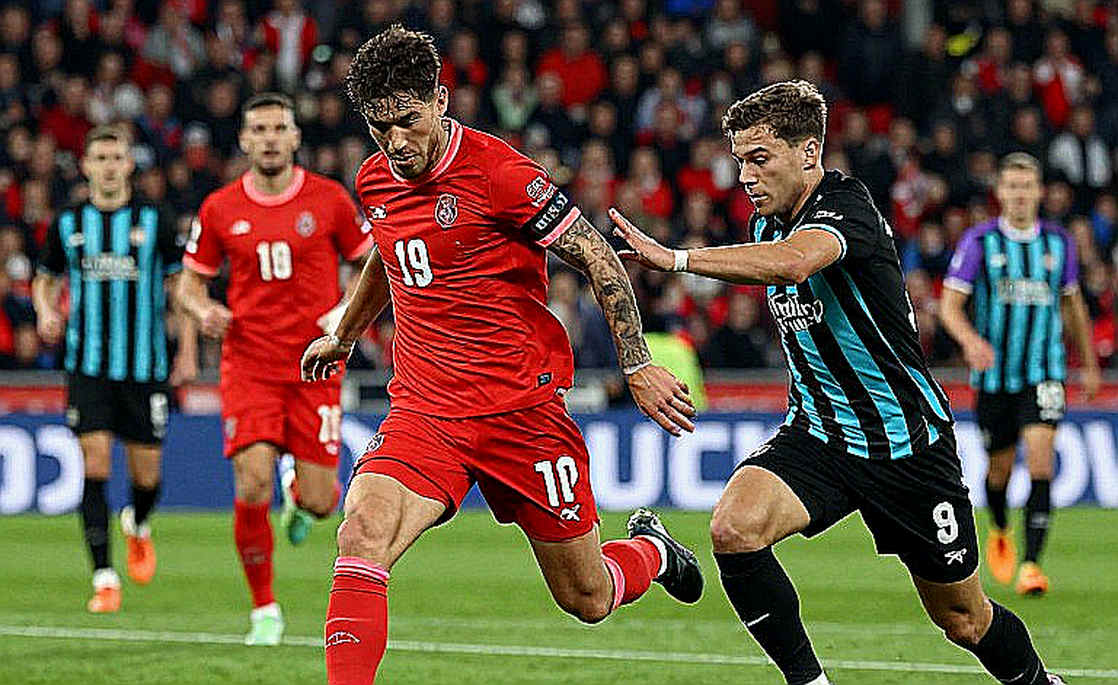
The report opens with confirmed fact. Fenerbahçe have appointed Emre Belözoğlu as head coach; the announcement came through the club's official channel; a signing ceremony took place; a club quotation about a 'deep bond' was reproduced. Belözoğlu is 46, this is his second stint, and he took charge of the final ten matches of the 2026/21 season. Then the bridge: İsmail Kartal has left Fenerbahçe, his fourth spell 'fell short of the targeted outcome', so the question is where he goes next. Then the payload: Tractor FC have made an official offer, Kartal is receptive, talks are progressing positively.
These three layers do not carry equal weight. The first is institutionally supported, checkable, quotable. The third is a claim with not one name behind it. Yet the report serves all three in the same register.
From the Russia 2026 fan-zone diary I learned something — moving through 200 voices teaches you that people's memory rests on announcements, not on inference. In 2026, watching European nights in empty stadiums, the same question stayed with me: who explains the gap between what is broadcast and what is happening? Writing about time-zone gaps in the Qatar 2026 diary taught me that distance is not only geographical — informational distance must be measured the same way.
With Fenerbahçe that distance is small, because the club speaks. With Tractor it is vast, because the club is silent. And that is the report's first structural problem: the institution that is the subject of the headline does not utter a single sentence in the entire piece.
Core analysis: the certainty ladder and its gaps
1. From headline to body — a descent
There is a ladder inside the report, and the reader descends it. In the headline the claim is present tense: 'is returning'. A few words later it is future: 'will sign'. In the body it becomes 'made an official offer'. Further down: 'reportedly receptive' and 'talks progressing well'.
A reader who stops at the headline absorbs a completed transfer. A reader who finishes the body absorbs an early-stage negotiation. These are not the same claim. Descent is normal in journalism, but here it is so fast that headline and body become two separate reports.
The largest problem is not that the claim may be false; it is that two entirely different levels of confidence are served in one register, in one paragraph, without a single marker of difference.
2. The halo of verification
Journalism has an old device best called the 'halo of verification': place a confirmed fact beside an unsourced claim and let its light make the claim credible. Here the halo is Fenerbahçe's official announcement. A reader who trusts that announcement assumes the whole piece operates at that standard — even though the announcement concerns an entirely different person: the man arriving, not the man leaving.
That light has a measurable effect. A reader who sees an official source in the first paragraph tends to apply the same standard to an anonymous claim in the last. This is structural deception — not intentional, but identical in outcome.
3. A sourcing audit of ten information points
Separate the facts and the picture clears. Belözoğlu's appointment and the club statement — institutional source, tier one. The ceremony, the second stint, age 46, the final ten matches of 2026/21 — the reporter's own observation, checkable but unchecked. Kartal's exit and the fourth-spell shortfall — narrative scaffolding. And Tractor's offer plus Kartal's 'receptive' response — tier four, zero named sourcing.
Eight of ten points have no external source. The single tier-one source supports the part of the story that is not the headline. The structure is a single point of failure: the entire newsworthiness hangs on an anonymous, uncheckable claim, while its credibility leans on an official statement about a different man.
4. 'Talks progressing positively' — a linguistic fingerprint
This sentence is one of the most familiar formulas in sports journalism. It has three properties: it cannot be verified, it benefits the party negotiating, and it can be denied if the deal collapses. Anyone writing it without a named source is dressing inference in the clothes of news.
The report does use 'iddiaya göre' — 'according to the claim' — but precisely where a source was most needed, the hedge is lightest. Surrounding sentences are declarative; the claim itself has a one-word fence.
5. What 'returning' does for free
The headline's 'returning to Iran' rests on an old fact — Kartal once coached Persepolis. But Tractor FC and Persepolis are different clubs, different cities, different cultures. Turning a first-time link into a homecoming inflates emotional weight without earning it. The reader imagines a homecoming; it is a first introduction to a new address.
Equally, withholding the club's name as 'that team' is an editorial decision, not a reporting one. It gives no information; it manufactures curiosity. Curiosity is fine, but when it replaces information, the reader is deceived.
6. The uncertainty of the word 'resignation'
The report says Kartal 'resigned'. Turkish managerial exits are frequently contract terminations or mutual separations later written up as resignations. If Kartal's deal simply expired, the word is wrong, and the compensation picture changes with it.
This matters because the report's entire causal logic rests on it. Did Kartal step aside before Belözoğlu's appointment, or was he moved out by it? The text's 'following his departure' implies the first; the narrative flow pushes toward the second. That difference is the report's largest unstated question.
7. 'The fourth spell fell short' — a vague insult
No points total, no final position, no cup run. 'Fell short of target' is a polite spelling of 'failed'. The reader cannot test the claim because the number is withheld. At a club like Fenerbahçe, where caretaker histories are tangled, 'fourth spell' is a specific, checkable count — asserted without support.
8. The biggest omission — Belözoğlu's coaching record
The appointment section discusses his bond with the club, his club identity, and reproduces club quotations. But there is not one sentence about his coaching record since 2026. Where has he coached, with what results, in what system? Nothing. The question the reader most needs answered is absent.
9. A report without a date
There is no publication date and no byline. In sports news this is not a small defect. A story whose validity expires in days, without a temporal anchor, leaves the reader unable to interpret anything. Today's reader and the reader three days later will take different meanings from the same text.
The contrarian angle: the problem is not whether the rumour is true
The most common reading of this report is: 'look, the Turkish media is spreading rumours again.' I think that reading is wrong, and wrong not only factually but methodologically.
First, the claim may well be false, but we do not yet know. Tractor may genuinely have made an offer. The problem is that we do not know — and the report has told us that we do. The difference is not between true and false; it is between knowing and claiming to know.
Second, this kind of report is not weak because journalists are dishonest, but because the architecture itself is rewarded. If the headline reads 'Tractor FC make offer for Kartal', clicks fall. If it reads 'he will sign', clicks rise. Market incentives push toward certainty, not truth. In the transfer market I have seen this machine repeatedly — the club that announces fastest gets attention; the club that waits stays correct.
Third, and most importantly, the story is told entirely from the Turkish side. The Iranian side is silent. Yet for this move the most reliable source is probably in Tehran, not Istanbul. Tasnim, ISNA, Varzesh3 — if none of them independently confirms the Kartal–Tractor link, the claim is unsupported. When a report covers an event between two countries but sees it through one country's eyes, half its information is invisible.
Fourth, the carousel narrative is suspiciously frictionless. Belözoğlu in, Kartal out, Tractor waiting — a closed loop with no friction. Real coaching markets have rival clubs, agent manoeuvring, stalled talks. None appear here. A story without friction usually has something removed.
One more thing lives inside this kind of writing. Football's rumour market has reached a point where 'interest' and 'agreement' are written with the same word. Clubs paying huge sums for young players operate on the same logic — selling possibility as certainty. The coaching market now uses the same arithmetic: more promise, less proof.
Takeaway: what to watch, when to stop
The report may yet prove true. But before it does, the reader needs a filter. My advice is simple: first, check whether Tractor FC has said anything itself. Second, check whether Iranian media has independently confirmed. Third, check whether Kartal or his agent has offered a sentence. If none of the three appears, the claim should be downgraded to 'reported interest', and the words 'he will sign' removed from the headline.
The open question: did Kartal's contract end in resignation or in expiry? The answer is one word, but it changes the meaning of the whole story. And the larger question: when Fenerbahçe is certain in its own announcement, why should another club's name hang on an unsourced claim? Our responsibility as readers is not small — stopping at the headline is now a conscious decision. What happened in that Chattogram group of 240 is happening in Turkey too, every day. Only the language differs.